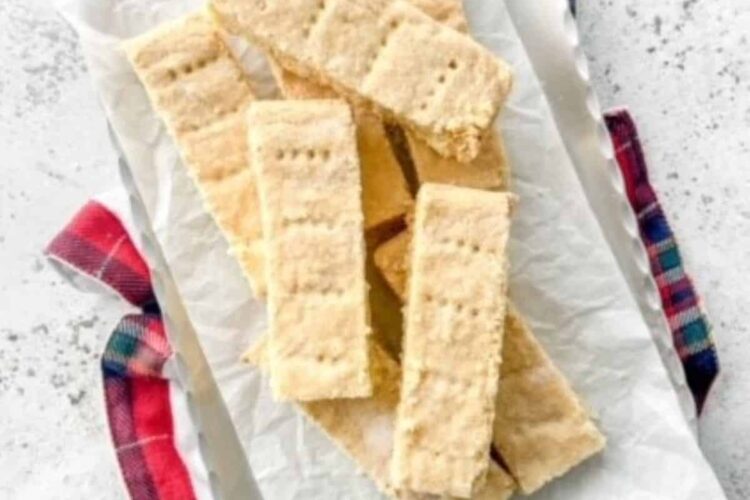
This Gluten free Scottish Shortbread recipe is super easy to make and only requires a few simple ingredients. Thick crunchy but crumbly fingers that are so buttery and just melt in your mouth as a true Scottish shortbread should be!
What is Scottish Shortbread
Scottish shortbread is a traditional Scottish baked treat known for its rich, buttery flavor and crumbly texture. It is a type of biscuit (cookie) that consists of simple ingredients: butter, sugar, and flour.
The name “shortbread” comes from the term “short,” which is used in baking to describe a pastry such as my gluten free shortcrust pastry or biscuit that has a crumbly and tender texture due to a high fat content, usually from butter or lard.
Shortbread is distinct from other biscuits or cookies because it has a high butter content, giving it a rich and buttery taste.
Shortbread is known to have originated in Scotland, where it has a long and rich history. Shortbread’s development can be traced back to medieval times when butter was a prized ingredient in Scottish cuisine.
The first known recipe for shortbread appeared in a Scottish cookbook called “The 18th Century Cookery Book” by Mrs. McLintock, published in 1736. Over the years the recipe has been adapted.
In Scotland, shortbread was traditionally served on special occasions such as Christmas, Hogmanay (New Year’s Eve), and Rabbie Burns Night alongside a glass of Scotch whiskey. Fast forward to the present day and shortbread is still as popular in Scotland and also enjoyed worldwide.
Course: Cookies
Cuisine: scottish
Diet: Gluten Free
Prep Time: 5 minutes
Cook Time: 55 minutes
Chill time: 15 minutes
Total Time: 1 hour 15 minutes
Servings: 12 Large Cookies
Calories: 353 kcal
Nutritional information is meant as a guideline and all information is approximate.
Equipment
- ▢8 x 8 Lined Baking pan
Ingredients
Ingredients for Gluten Free Shortbread
- ▢280 grams Unsalted Butter Room temperature
- ▢150 grams Superfine Sugar (Optional- Plus 1 tablespoon extra for sprinkling over the finished shortbread) Such as Caster or Bakers sugar (It is a finely granulated sugar that is finer than granulated sugar but not as powdery as powdered confectioner’s sugar).
- ▢370 grams Gluten free All puropse Flour
- ▢70 grams Cornstarch Also known as cornflour in the UK
- ▢⅛ teaspoon Salt
- ▢½ teaspoon Xanthan Gum
- Place a sheet of parchment paper at the bottom and along the sides to line the baking pan.I recommend leaving some excess paper over the edges of the pan to make it easier when removing the shortbread.
- In a bowl, beat together butter and sugar until fully combined but not creamed as we don’t want to add any air into the shortbread dough.
- In a large bowl mix together the flour, cornstarch, xanthan gum, and salt.
- Combine the flour mix with the butter and sugar mixture and knead together until it forms a dough.
- Place the dough into the lined baking pan and spread out evenly.I like to use my hands to spread it in the pan and then use a small offset spatula to smooth out the surface.If preferred you can roll the dough on a piece of parchment paper to the size of the pan then lift it into the pan.
- Using a knife cut into the dough about ¾ deep to score in the shape of the shortbread fingers and then pierce each shortbread finger with a fork a few times (See image 5 in the post above).
- Place the Shortbread dough in the fridge for 15 minutes and Preheat the oven to 180°C/350°F/Gas mark 4.
- Place in the oven for 50-60 minutes (Mine took 55 minutes) until slightly golden around the edges. Remove from the oven and place the baking pan on a cooling rack.
- With a knife carefully go over the lines previously made while the shortbread is still soft. Sprinkle the top with the optional sugar if desired.
- It is important to leave the gluten free shortbread in the baking pan on the cooling rack to fully cool before removing it from the pan as it will firm up nicely once fully cooled.
Notes
- Tip #1: Quality ingredients – Using high-quality ingredients such as European butter that has a lower water content is essential as there are very few ingredients needed to make the gluten free shortbread so it really matters when it comes to achieving the best texture and flavor.
- Tip #2: Don’t overbeat – Stop beating once the butter and sugar are fully incorporated as too much air through over-beating will cause the top of the shortbread to puff up when baking and we don’t want that.
- Tip #3: Pricking the top – By scoring the lines of the shortbread cookies finger will make it easier for clean cuts after they have cooled. Pricking the tops of the cookies before baking will allow air to escape and help prevent the shortbread from puffing up during the baking process.
- Tip #4: Chilling the dough – Chilling shortbread dough before baking helps solidify the butter, reduce cookie spread, enhance flavor, and make the dough easier to handle for a tender, crumbly texture and well-defined shape.
- Tip #5: Let it fully cool – It is important to leave the gluten free shortbread in the baking pan on the cooling rack to fully cool after baking before removing it from the pan as it will firm up nicely once fully cooled.
Nutrition
Serving: 1Large Cookie | Calories: 353kcal | Carbohydrates: 44.8g | Protein: 0.4g | Fat: 18.5g | Saturated Fat: 11.7g | Cholesterol: 49.9mg | Sodium: 100.5mg | Potassium: 0.2mg | Fiber: 0.5g | Sugar: 12.5g
Disclaimer
Nutritional information is meant as a guideline and is always an approximate calculation. Recipes may include information of various products used. It is your responsibility to check that ingredients you use when making a recipe are gluten free.
